
Margin Master Handbook
- Prerequisites
- Firewall and Network Requirements
- Microsoft Edge Download Block
- SQL Server Authentication Setup for IT Administrators
- Antivirus and Endpoint Security Exclusions
- SQL Server Tools
- Install or Upgrade SQL Server Express
- Install or Upgrade SQL Server Management Studio
- Database Connection Setup
- Database Creation
- Database Restore
- Transfer Settings from Database
- Connecting a Second Computer
- A Tour of the Main Window
- The Menus
- The Button Row
- The Main Data Grid
- The Summary Section
- Banners and Badges
- The Options Window
- Store Configuration
- Miscellaneous
- Export Options
- Vendor Settings
- POS / Connections Tabs
- Background Service
- AI Assistant (Experimental)
- How POS Import Works
- Supported Point-of-Sale Systems
- Data Import Workflows
- RockSolid POS Import
- Epicor Eagle FTP Import
- Epicor MySQL Compass Import
- Transact POS Import
- Paladin POS Import
- Falcon POS Import
- Spruce POS Import
- Bistrack POS Import
- RockSolid Max POS Import
- ECS POS Import
- Prosperity POS Import
- Catalyst POS Import
- Westlake POS Import
- MI9 POS Import
- AS/400 POS Import
- CounterWorks POS Import
- Dimension POS Import
- PacSoft POS Import
- ProStix POS Import
- Sympac POS Import
- Propello POS Import
- EagleVision POS Import
- MySQL/Compass Connection Configuration
- ECI VPN Requirement (Spruce, RockSolid MAX)
- Propello POS Integration Guide
- MI9 Data Pipeline — Import to Main Table
- Troubleshooting: Epicor Import Brought In 0 SKUs
- PACE POS Import
- Advantage POS Import
- General Store POS Import
- J-3 POS Import
- KeyStroke POS Import
- AutBusSystem POS Import
- Tomax POS Import
- Enterprise POS Import
- Computakey POS Import
- Redisell POS Import
- DART POS Import
- MIB POS Import
- Substruct POS Import
- DMAS POS Import
- RODS POS Import
- Procom POS Import
- Agility POS Import
- Acumen POS Import
- Cruise POS Import
- LSandE POS Import
- Retalix POS Import
- DIBCorp POS Import
- GMROI POS Import
- ECi Advantage POS Import
- Sunray POS Import
- ActivantAutomotive POS Import
- IBS POS Import
- Versys POS Import
- RMS POS Import
- TAMS POS Import
- Integrasoft POS Import
- Dynamic POS Import
- Microsoft ARS POS Import
- CDS POS Import
- Spartan POS Import
- Nitterhouse POS Import
- Jeds POS Import
- Theisens POS Import
- Emery Jensen POS Import
- SMS Pro POS Import
- Burdens POS Import
- Intact POS Import
- Bloom Retail POS Import
- NCR Counterpoint POS Import
- Horizon POS Import
- Cloud Vendor Data Sync
- Data Aging and Freshness Warnings
- Resetting Vendor and POS Data
- Rebuild Data and Rebuild Selection Lists
- Troubleshooting Vendor Sync
- Understanding the Strategy Hierarchy
- Pricing Strategies
- Creating a Strategy Step
- Updating and Deleting Steps
- Reviewing a Strategy and Running It
- Shared (Premade) Strategies
- SKU-Level Exceptions
- Manage Custom Groups
- Strategy Execution Cloud Tracking
- Importing from Excel
- Cost Break Analysis
- Cost Break Strategies
- Min/Max Strategies
- Strategy Backup & Restore
- Add Items from Catalog
- Store Grouping
- Data Diagnostics and Missing Index Recommendations
- System Diagnostics
- Margin Master Cannot Save Settings
- SQL Server 2025 Express vs. Full License
- Support Issue Management
- Catalog Lookup
- What's New After an Update
- Version History
- Documentation and the Help Buttons
- CTLD — Do It Best Catalog File
- MARGIN_MASTER — Ace Catalog File
- PCDITEMXREF — Do It Best SKU Classification File
- SAP_ZONE_PRICE_MARGIN_MASTER — Ace Zone Pricing File
- PCDPRODCLASS — Do It Best Product Classification Hierarchy File
- SAP_STORE_DEPT_ZONE_MARGIN_MASTER — Ace Store Zone Assignment File
- Taxonomy — Ace Product Classification File
- Mapp_Pricing — Ace MAP & IMAP Pricing File
- margin_mstr_plano — Ace Planogram File
On This Page
Bistrack POS Import
What is this?
Bistrack is the most feature-rich POS import in Margin Master, supporting five different import variants to accommodate different store configurations. It can import from comma-delimited files or connect directly to a live Bistrack SQL Server database.
Walk through it in the app: guide 4006 — Importing your BisTrack data. Margin Master can walk you through these steps live: turn on Training / Guide Mode from the Help menu, then type 4006 into the Lessons & Guides box — or ask Margin Master support to run it with you.
Import File Format
| Property | Value |
|---|---|
| Delimiter | Comma (,) |
| File pattern | *.txt or *.csv |
| Header row | Yes (1 row) |
| Variants | Standard, DIB1040, DIB6828, MAP1, DirectConnect |
Standard Variant (37 fields)
| # | Field | Description |
|---|---|---|
| 1 | Sku | Item SKU |
| 2 | AltSku | Alternate SKU / UPC |
| 3 | Store | Store identifier |
| 4 | Dept | Department |
| 5 | Class | Class |
| 6 | Description | Item description |
| 7 | Desc2 | Secondary description |
| 8 | Location | Bin/location |
| 9 | CurrentPrice | Current retail price |
| 10 | OnHand | Quantity on hand |
| 11 | PrimeVendor | Primary vendor |
| 12 | AVendor | Alternate vendor |
| 13 | ProductGroup | Product group |
| 14 | OrderMultiple | Order multiple |
| 15 | RetailUnits | Retail units (ignored) |
| 16-28 | H0 - H12 | Monthly sales history (13 months) |
| 29 | COST | Item cost |
| 30-34 | Comp1 - Comp5 | Competitor prices 1-5 |
| 35 | CompA | Competitor price A |
| 36 | CompMemo | Competitor memo |
| 37 | sVelocity | Sales velocity |
DIB6828 Variant (16 fields)
A reduced format without Location, PrimeVendor, AVendor, ProductGroup, or competitor fields:
| # | Field | Description |
|---|---|---|
| 1 | Sku | Item SKU |
| 2 | AltSku | Alternate SKU |
| 3 | Store | Store identifier |
| 4 | Dept | Department |
| 5 | Class | Class |
| 6 | Description | Item description |
| 7 | CurrentPrice | Current retail price |
| 8 | OnHand | Quantity on hand |
| 9 | OrderMultiple | Order multiple |
| 10-22 | H0 - H12 | Monthly sales history |
| 23 | COST | Item cost |
DirectConnect Variant
Instead of importing a file, DirectConnect queries your live Bistrack SQL Server database directly:
- Reads from
Product,Stock, andSupplierProducttables - Only exports items flagged with
udfExportToMarginMaster = 1 - Uses cursor-based pricing calculations for accurate cost data
- Performs batch inserts using bulk operations
How Import Works
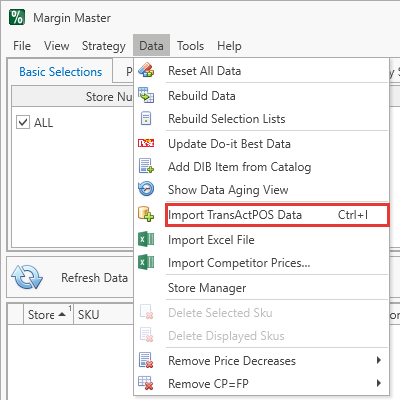
File-Based Import (Standard, DIB1040, DIB6828, MAP1)
Bistrack file imports run in two phases:
- Preload phase — Margin Master reads all import files and loads the raw data into a preload table in one pass. This step handles all files together (cross-file batching), so multi-file imports are processed efficiently regardless of the number of stores.
- Build phase — The preloaded data is used to build the final per-store tables. Because the preload is already done, this step does not re-read any files.
The progress bar reflects both phases, so you see accurate progress across the full import rather than restarting at 0% per file.
DirectConnect Import
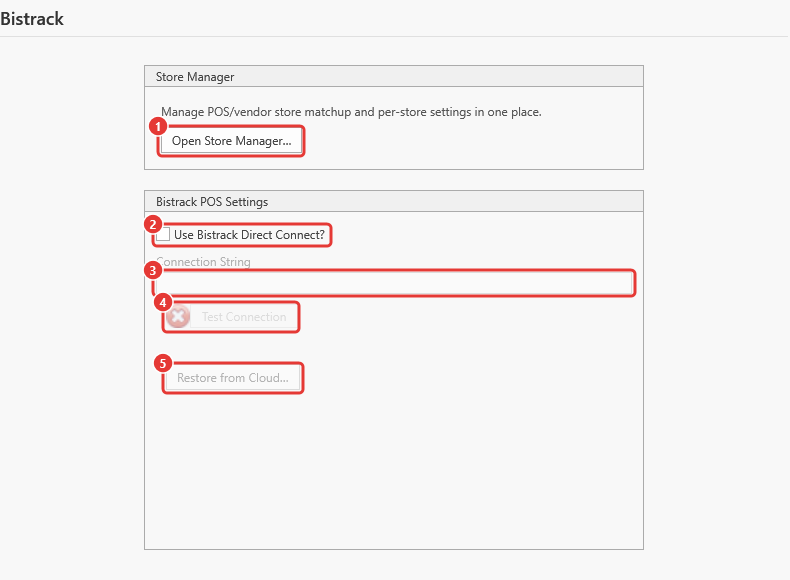
Open Store Manager... - POS/vendor store matchup.
Use Bistrack Direct Connect? - switch from file import to the live database.
Connection String for the Bistrack SQL Server.
Test Connection.
Restore from Cloud...
Margin Master connects to your Bistrack SQL Server using the connection string configured in Options.
It queries the Product, Stock, and SupplierProduct tables, filtering for items flagged for export.
Pricing is calculated using cursor-based logic within the Bistrack database.
Results are bulk-inserted into the local database using Z.BulkOperations.
Field Mapping
| Bistrack Field | Margin Master Column | Notes |
|---|---|---|
| Sku | SKU | Item SKU |
| AltSku | AltSku | Alternate SKU / UPC |
| Store | Store | Store identifier |
| Dept | Dept | Department |
| Class | Class | Class |
| Description | Description | Item description |
| Desc2 | Desc2 | Secondary description (Standard only) |
| Location | Location | Bin/location (Standard only) |
| CurrentPrice | CurrentPrice | Current retail price |
| OnHand | OnHand | Quantity on hand |
| PrimeVendor | PrimeVendor | Primary vendor (Standard only) |
| AVendor | AVendor | Alternate vendor (Standard only) |
| ProductGroup | ProductGroup | Product group (Standard only) |
| H0 - H12 | History0 - History12 | Monthly sales history |
| COST | COST | Item cost |
| Comp1 - Comp5 | Comp1 - Comp5 | Competitor prices (Standard only) |
| sVelocity | sVelocity | Sales velocity |
Pricing a Purchase Order
You can price just the items on one open purchase order. Export the PO from Bistrack in the same
layout as your normal catalog export and name the file PO followed by the purchase order number -
for example PO1015900.csv.
Put the file wherever your other Bistrack exports go: your Import Path (Tools > Options > Miscellaneous), a yard folder under your Network Import Root, or a sub-folder of the Import Path. Purchase order files are the one exception to the current-folder-only rule - Margin Master looks in sub-folders for them.
Then choose Data > Get POS Data as usual. Margin Master reports what it did with each PO.
What happens to a purchase order file:
| The purchase order number | comes from the file name - PO1015900.csv becomes 1015900 |
| The yard | comes from the file's own Store column, not the folder it sits in. The export must include that column |
| The tag | every item on the PO is tagged {yard}-{PO number} - for example 23-1015900 - in the PO Number field |
| New items | items on the PO that are not in the yard yet are looked up in the Do it Best catalog and added so you can price them. Items the catalog does not have are reported and skipped |
| The catalog | is never rebuilt from a purchase order. A PO lists only part of a yard, so it only ever adds and tags - it cannot replace the yard's items |
To price the order, pick its number from the PO Number selection box, then price and export as you normally would.
The PO Number tag clears itself. Once Bistrack exports one of those items in a normal catalog export, the item comes back untagged. Price a purchase order before the yard's next export, or re-apply the PO file.
The purchase order file is not renamed
.BAKafter it is used, so it is re-applied on every import while the order is open. Delete it once the order is closed.
A purchase order for a yard you have never imported cannot be tagged - there are no items to tag. Import that yard's catalog file first, then run the import again.
Troubleshooting
| Symptom | Likely cause | What to do |
|---|---|---|
| No Files Found when you choose Get POS Data | The export is not in the Import Path (Tools > Options > Miscellaneous), or its name does not match the pattern above | Check the path and the file name; Margin Master reads only the current folder, not sub-folders (purchase order files are the exception - see above) |
| A purchase order is not tagged, and the message says the yard has no data | That yard has never been imported, so there are no items to tag | Import that yard's catalog file, then run the import again |
| A purchase order says its yard is unknown | The export is missing the Store column, so Margin Master cannot tell which yard the order belongs to | Re-export the PO including the Store column |
| A PO Number you priced has disappeared | The yard was exported again, and the tag cleared as designed | Re-apply the PO file, or price the order before the yard's next export |
| Stores you did not import are listed after an import | Normal when you import one yard at a time - their data is left untouched | Nothing. To remove a yard permanently use Store Manager |
| The same file is imported again and again | The previous import's file was not renamed | After a successful import the file is renamed to NAME[ext].BAK; a file that keeps its name did not import - read the error dialog |
| 0 records or far fewer than expected | The export covers the wrong store, or the store is not matched in the Store Manager | Open Store Manager and check the store's row; re-export from the point of sale |
| Columns land in the wrong fields | The export layout changed | Compare the file's header row with Field Mapping above; contact Margin Master support with the file |
| Import finishes but the grid does not change | The rebuild was postponed (the Click to update data badge is showing) | Click the badge, or Data > Rebuild Data |
Every import failure shows one error dialog; the log under File > Utilities > Show Log Files has the detail to send to support.
Tips
If you are unsure which Bistrack variant to use, start with the Standard variant. Your Bistrack administrator can confirm which export format your system produces.
For DirectConnect, make sure the
udfExportToMarginMasterflag is set to1on the items you want to analyze in Margin Master. Items without this flag are skipped.
The DIB6828 variant is a simplified format with fewer fields. Use it if your export does not include location, vendor, or competitor data.
Configure Bistrack settings in Options > Bistrack tab, including the connection string for DirectConnect mode.
Common Questions
Q: Which Bistrack variant should I use? A: Your store's Bistrack export format determines the variant. If you have a 37-column CSV with competitor prices, use Standard. If you have a 16-column file, use DIB6828. Your Bistrack administrator or Margin Master support can help identify the correct variant.
Q: What is DirectConnect and when should I use it?
A: DirectConnect queries your Bistrack SQL Server in real time instead of importing a file. Use it if you want the most current data without manually exporting files. It requires network access to your Bistrack database and the UseDirectConnect toggle enabled in Options.
Q: My DirectConnect import is very slow. Is that normal? A: DirectConnect uses cursor-based pricing calculations, which can be slower for large catalogs. The bulk insert step is fast, but the pricing query depends on your Bistrack database size and server performance.
Q: File-based imports seem faster than they used to be. Why? A: A performance rewrite in mid-2026 eliminated an N² processing loop that previously processed each store against every import file independently. The new pipeline preloads all files first, then builds all stores in one pass — significantly faster for multi-store setups.
Q: What does the RetailUnits field do? A: In the Standard variant, RetailUnits (field 15) is read from the file but ignored during import. It is not mapped to any Margin Master column.